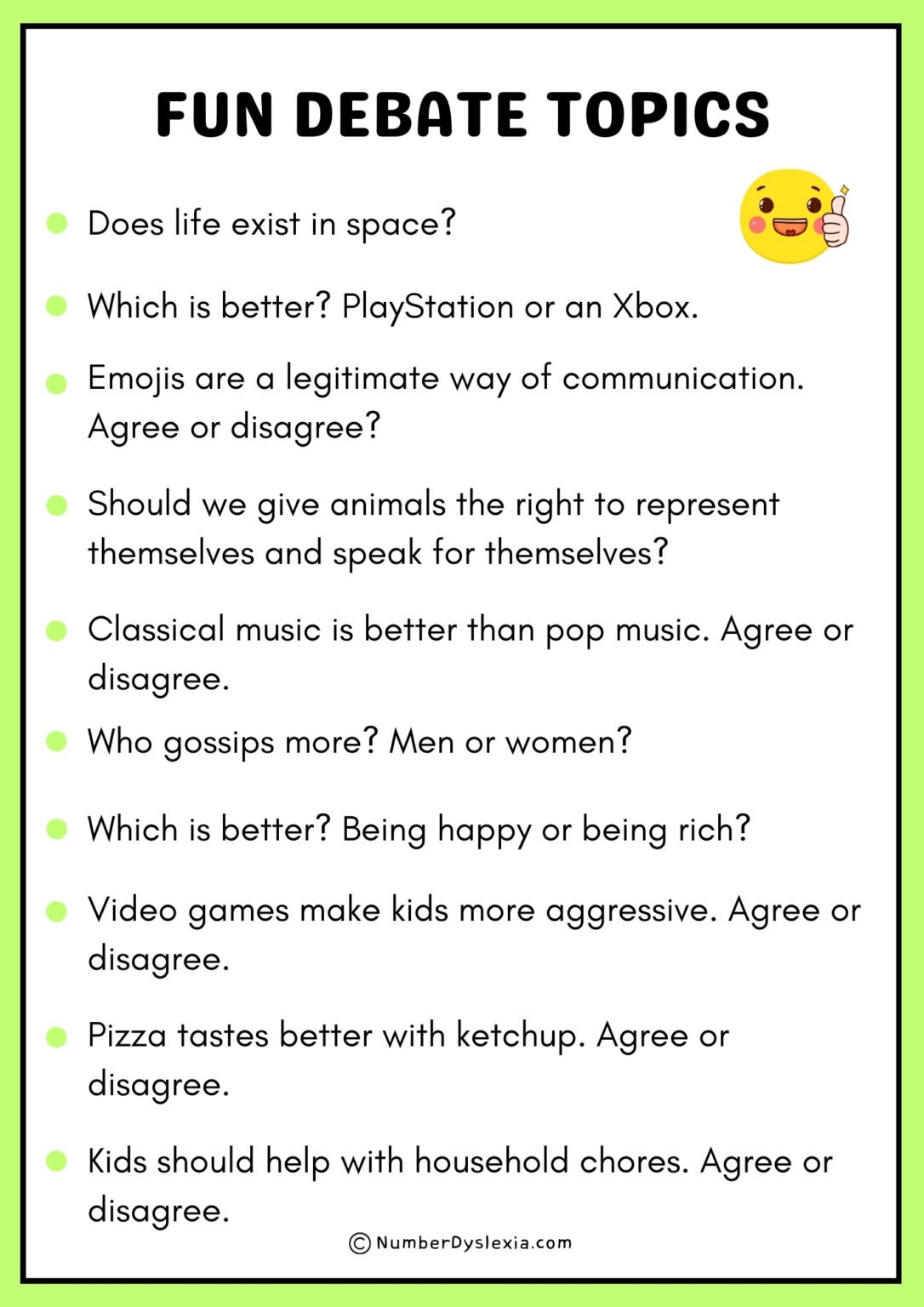
Ready to transform your classroom into a buzzing hub of critical thought? It starts with the right spark. Effective Discussion & Debate Prompts are more than just conversation starters; they're meticulously crafted invitations to inquiry, analysis, and articulate expression. They challenge students to step beyond passive learning and actively engage with complex ideas, forming their own viewpoints, and confidently defending them.
In a world brimming with information—and misinformation—the ability to think critically, communicate clearly, and empathize with differing perspectives isn't just a desirable skill; it's essential for navigating college, career, and citizenship. This comprehensive guide will equip you with a treasure trove of prompts and the strategies to wield them, turning every discussion into a powerful learning experience.
At a Glance: Your Toolkit for Cultivating Critical Thinkers
- Why Debate? It builds critical thinking, public speaking, research, empathy, and evidence analysis.
- Choose Wisely: Select prompts based on student interest, potential for strong opposing arguments, and data availability.
- Diverse Topics: Explore categories from education and technology to ethics and politics.
- Preparation is Key: Guide students to research thoroughly, anticipate counter-arguments, and practice clear articulation.
- Facilitate, Don't Dominate: Your role is to foster respectful exchange, not dictate outcomes.
- Beyond Winning: The goal is to cultivate thoughtful, engaged citizens, not just triumphant debaters.
The Untapped Power of Thought: Why Bother with Debate?
In an era of soundbites and echo chambers, truly deep, analytical thinking often feels like a lost art. Yet, it's never been more crucial. This is where the power of structured discussion and debate truly shines. It’s an activity that, while sometimes perceived as confrontational, is fundamentally about rigorous intellectual exploration.
Think about the skills that propel success in any field: the ability to dissect a problem, gather relevant information, construct a logical argument, present it persuasively, and perhaps most importantly, listen actively and respectfully to an opposing view. These aren't soft skills; they're foundational competencies that prepare students for the academic rigor of higher education and the complex decision-making demanded in professional life.
Debate nurtures:
- Critical Thinking: Students learn to question assumptions, evaluate evidence, and identify weak reasoning. They move beyond simply accepting information to truly understanding it.
- Confident Public Speaking: Overcoming the fear of speaking in front of peers is a massive step. Debate provides a structured, low-stakes environment to practice clarity, projection, and conviction.
- Clear Expression of Ideas: It forces students to organize their thoughts, articulate complex concepts succinctly, and use precise language. Muddled thinking gets exposed quickly in a debate.
- Consideration of Different Viewpoints: By having to research and sometimes even argue a position they initially disagree with, students develop empathy and a more nuanced understanding of multifaceted issues. As Meredithplays.com notes, formats like the Ethics Bowl even emphasize collaborative exploration over head-to-head confrontation.
- Research & Evidence Analysis: Students learn how to find credible sources, differentiate fact from opinion, and use empirical data to strengthen their arguments. Prepscholar.com rightly stresses the need for "ample empirical data" to support arguments.
- Logical Argument Construction: They practice building a case step-by-step, connecting premises to conclusions, and anticipating counter-arguments. This is the scaffolding for all robust reasoning.
Ultimately, the primary goal isn't to declare a "winner" in a contentious argument. Instead, it's about cultivating thinkers who can question, analyze, communicate effectively, and handle complex issues with respect, even when opinions diverge. It's about empowering them to be informed, articulate participants in their communities and the wider world.
Crafting the Perfect Prompt: What Makes a Good Debate Topic?
Not all questions are created equal when it comes to sparking a lively, educational debate. A strong prompt is like a finely tuned instrument, designed to draw out specific skills and encourage rich discussion. Prepscholar.com outlines three excellent criteria for selecting topics, and we'll expand on them here:
- Interest: Does it Spark Curiosity?
- The Principle: If students aren't genuinely interested, the debate will fall flat. A topic that resonates with their current experiences, studies, or concerns will immediately engage them.
- Actionable Insight: Don't be afraid to solicit ideas directly from students. What issues are they discussing with friends? What's in the news that impacts their lives? Aligning topics with their interests is key to effective engagement. For younger students, lighter, more immediate topics (like school rules) can be highly engaging, while older students can tackle broader societal issues.
- Argument Potential: Are There Two Sides (or More) with Solid Ground?
- The Principle: A great debate prompt must have at least two defensible, well-supported opposing sides. Avoid topics where one side is objectively "right" or where there's a clear consensus. Similarly, avoid topics that are purely matters of personal preference without broader implications.
- Actionable Insight: Look for propositions that invite "should" or "should not" questions. For example, "Is social media bad for teenagers?" is debatable, whereas "Do people use social media?" is a factual question, not a debate. The best prompts often involve a conflict of values, priorities, or interpretations of evidence.
- Availability of Data: Can Arguments Be Backed by Evidence?
- The Principle: Opinions are nice, but evidence is king. Students need access to reputable sources—studies, statistics, expert opinions, historical precedents—to build strong arguments.
- Actionable Insight: Before presenting a topic, do a quick search yourself. Can students find enough credible information to support both sides? If the information is too obscure or requires highly specialized knowledge, it might be better to save it for a more advanced group or modify the prompt. This also reinforces the vital skill of research and discerning reliable sources.
By applying these three filters, you'll move beyond simple questions to craft prompts that are ripe for deep intellectual exploration.
The Ultimate Prompt Library: A Universe of Ideas for Every Learner
Here's a comprehensive collection of discussion and debate prompts, categorized to help you find the perfect fit for your students' age, interests, and learning objectives. We've drawn heavily from the wealth of ideas offered by Meredithplays.com and Prepscholar.com, expanding and refining them for maximum impact.
1. Education & Future Learning
These prompts delve into the very system students inhabit, encouraging them to critically examine what, how, and why they learn.
- "Should homework be banned entirely from schools?" (Prepscholar.com, Meredithplays.com)
- "Are school uniforms beneficial or detrimental to student expression and equality?" (Meredithplays.com, Prepscholar.com)
- "Should standardized tests be abolished as a measure of student achievement?" (Prepscholar.com)
- "Is online learning as effective as traditional in-person schooling?" (Meredithplays.com)
- "Should financial literacy or civics be mandatory subjects for all students?" (Meredithplays.com)
- "Should college athletes be paid beyond scholarships for their participation in sports?" (Meredithplays.com)
- "Should public college tuition be free for all students?" (Prepscholar.com)
- "Is year-round schooling a better model for student learning and retention?" (Prepscholar.com)
2. Tech & The Digital Frontier
Rapid technological advancements bring a host of ethical dilemmas and societal changes. These prompts encourage students to think about the digital world's impact.
- "Should social media companies be held responsible for the mental health effects on teenagers?" (Meredithplays.com, Prepscholar.com)
- "Should artificial intelligence (AI) be strictly regulated by governments?" (Meredithplays.com, Prepscholar.com)
- "Do the benefits of self-driving cars outweigh the risks?" (Meredithplays.com)
- "Is online privacy an outdated concept in an age of national security concerns?" (Meredithplays.com)
- "Should humans continue to invest heavily in space exploration instead of focusing on Earth-bound problems?" (Meredithplays.com, Prepscholar.com)
- "Are violent video games a significant contributor to aggressive behavior in youth?" (Meredithplays.com)
- "Should individuals have complete ownership and control over their genetic information (DNA)?" (Prepscholar.com)
3. Science, Health & Environment
From climate change to personal well-being, these topics often involve scientific data, ethical considerations, and the future of our planet.
- "Should animal testing for cosmetic products be completely banned?" (Meredithplays.com, Prepscholar.com)
- "Is nuclear energy a viable and safe solution for future energy needs?" (Meredithplays.com)
- "Should plastic bags and single-use plastics be banned nationwide?" (Meredithplays.com)
- "Are genetically modified foods (GMOs) safe and beneficial for global food security?" (Meredithplays.com)
- "Should fast food companies be held responsible for the obesity epidemic?" (Meredithplays.com)
- "Is mandatory vaccination an infringement on personal liberty or a public health necessity?" (Meredithplays.com, Prepscholar.com)
- "Should cosmetic procedures for teenagers be regulated or banned?" (Meredithplays.com)
- "Is euthanasia ever ethically justifiable for terminally ill patients?" (Prepscholar.com)
- "Should vaping products be banned outright?" (Prepscholar.com)
4. Society, Culture & Human Rights
These prompts tackle sensitive and complex issues related to justice, equality, and societal norms.
- "Should mandatory voting be implemented in democratic nations?" (Meredithplays.com)
- "Is the legal drinking age of 21 still appropriate, or should it be lowered?" (Prepscholar.com)
- "Should cultural appropriation be considered a serious offense?" (Meredithplays.com)
- "Do parents bear ultimate responsibility for the criminal actions of their minor children?" (Meredithplays.com)
- "Is gender pay equality achievable, and what steps should be taken to ensure it?" (Meredithplays.com)
- "Should universal healthcare be a right for all citizens?" (Meredithplays.com, Prepscholar.com)
- "Is there a place for beauty pageants in modern society?" (Meredithplays.com)
5. Politics, Governance & Global Affairs
Exploring governance, policy, and international relations helps students understand their role in the broader political landscape.
- "Should the voting age be lowered to 16?" (Meredithplays.com)
- "Is democracy unequivocally the best form of government?" (Meredithplays.com)
- "Should there be age limits for political leaders?" (Meredithplays.com)
- "Is the death penalty a just and effective form of punishment?" (Meredithplays.com, Prepscholar.com)
- "Should nations implement open border policies?" (Meredithplays.com)
- "Is public prayer in schools an appropriate exercise of religious freedom?" (Prepscholar.com)
- "Should human cloning be legalized for any purpose?" (Prepscholar.com)
6. Economy, Business & Resources
These prompts touch upon economic policies, wealth distribution, and the nature of work.
- "Should the minimum wage be significantly increased?" (Meredithplays.com, Prepscholar.com)
- "Is universal basic income (UBI) a viable solution to poverty and economic inequality?" (Meredithplays.com, Prepscholar.com)
- "Should wealthy individuals and corporations be taxed at a much higher rate?" (Meredithplays.com)
- "Are unpaid internships ethical and beneficial for students entering the workforce?" (Meredithplays.com)
- "Is globalization primarily beneficial or detrimental to developing nations?" (Meredithplays.com)
- "Should students be paid for good grades?" (Meredithplays.com)
7. Ethics, Morality & The Human Condition
These are the big questions that challenge students to grapple with fundamental moral principles.
- "Is lying ever morally justifiable?" (Meredithplays.com)
- "Should wealth be redistributed more equitably across society?" (Meredithplays.com)
- "Does humanity have a moral obligation to prevent all wars?" (Meredithplays.com)
- "Do animals have the same rights as humans?" (Meredithplays.com)
- "When, if ever, is self-defense justified to the point of lethal force?" (Meredithplays.com)
- "Are all drugs, including currently illegal substances, candidates for legalization?" (Prepscholar.com)
8. Media, Entertainment & Influence
In an age of constant media consumption, these prompts encourage students to critically analyze the messages they receive.
- "Do celebrities have a moral obligation to be positive role models?" (Meredithplays.com)
- "Should reality TV shows be banned due to their potentially negative influence?" (Meredithplays.com)
- "Should social media platforms be responsible for regulating content shared by users?" (Meredithplays.com)
- "Is censorship of music, movies, or books ever justified?" (Meredithplays.com)
- "Should news outlets be legally required to present balanced coverage of political issues?"
9. Sports & Competition
Often reflecting broader societal values, sports prompts can be surprisingly rich ground for debate.
- "Should violent sports, like boxing or American football, be banned for young athletes?" (Meredithplays.com)
- "Is the importance placed on sports in schools disproportionate to academics?" (Meredithplays.com)
- "Should e-sports be recognized and treated as legitimate 'real' sports?" (Meredithplays.com)
- "Is the use of performance-enhancing drugs ever acceptable in professional sports?" (Meredithplays.com)
- "Should gender-segregated sports teams be abolished in favor of co-ed teams?" (Meredithplays.com)
10. Fun, Creative & Hypothetical Prompts
Sometimes, a lighter or more imaginative prompt can be the perfect entry point, especially for younger or less experienced debaters. These topics often allow for creative thinking without needing extensive external research.
- "Should the school day be shorter, even if it means less instruction time?" (Meredithplays.com)
- "Should students have a say in choosing their teachers or school rules?" (Meredithplays.com)
- "Should pets be allowed in the classroom?" (Meredithplays.com)
- "Is it better to have a longer summer vacation or more frequent, shorter breaks throughout the year?" (Meredithplays.com)
- "If you could invent one new school subject, what would it be and why?"
- "Is it better to be incredibly smart but socially awkward, or average intelligence but very popular?"
When selecting, remember the core principles: student interest, two-sided argument potential, and data availability. And if you're ever looking for a fresh spark, sometimes all it takes is a random prompt to get the ideas flowing. For a continuous stream of fresh ideas, you might find Our random questions generator to be an invaluable resource, offering unexpected angles to explore.
Beyond the Prompt: Preparing Students for Powerful Discussions
A great prompt is just the beginning. The real magic happens in how students prepare and engage. Your role as a facilitator is crucial in guiding them through the process, ensuring they develop the skills that truly matter. Prepscholar.com offers excellent advice for debaters, which we can adapt for your guidance.
1. Guiding Their Research: Read Your Evidence
Before any words are spoken, thorough research is paramount. Encourage students to:
- Seek Reputable Sources: Emphasize the difference between credible academic journals, news organizations, and less reliable blogs or social media posts.
- Gather Diverse Perspectives: Don't just look for information that supports their assigned side. Understanding the opposing viewpoint before the debate strengthens their own argument.
- Extract Key Data: Teach them to identify statistics, expert quotes, and historical precedents that directly support their claims.
- Organize Their Findings: Suggest using note cards, digital documents, or outlines to keep their evidence accessible and structured.
2. Anticipating the Other Side’s Arguments: Play Devil's Advocate
This is where critical thinking truly gets a workout. Ask students to:
- Brainstorm Counter-Arguments: What would the other side say? What are their strongest points?
- Identify Weaknesses in Their Own Case: Where are the potential holes in their logic? What questions might arise that they haven't considered?
- Prepare Rebuttals: For each anticipated counter-argument, have them draft a concise and evidence-based response. This proactive approach builds confidence and resilience.
3. Structuring Their Speech: Plan to Fill Your Time
Debate isn't just about having good ideas; it's about presenting them effectively within a time constraint. Teach students to:
- Outline Their Argument: A clear structure (introduction, main points with evidence, conclusion) is vital.
- Allocate Time Wisely: Practice speaking through their argument, noting where they might need more evidence or where they can condense. Adding more supporting evidence is often a good way to fill time without repetition.
- Practice Delivery: Rehearse speaking slowly and clearly, ensuring every word is understood. Jargon should be explained, and complex ideas broken down.
4. Fostering Confidence: Practice Makes Progress
Public speaking is often cited as a top fear. Consistent practice in a supportive environment is the only way to overcome it.
- Low-Stakes Practice: Start with small group discussions or practice rounds before a formal debate.
- Peer Feedback: Encourage constructive criticism from classmates on clarity, volume, and argument strength.
- Record Themselves: Watching themselves back (optional, with permission) can be a powerful tool for self-correction.
- Remind Them of the Goal: Reiterate that the goal is intellectual growth, not necessarily "winning" at all costs. It's okay to stumble; it's part of learning.
Common Pitfalls & How to Dodge Them
Even with the best prompts and preparation, debates can hit snags. Here's how to anticipate and manage common challenges:
- The "Shy Speaker" Syndrome:
- Solution: Start small. Assign roles that don't require solo speaking initially (e.g., note-taker, evidence finder). Use smaller group discussions before moving to full-class debates. Offer opportunities for students to submit written arguments if oral presentation is too daunting.
- One Side Dominates:
- Solution: Establish clear rules for turn-taking and speaking time. Use a timer. Empower a student timekeeper. As a facilitator, step in to redirect or ensure quieter voices are heard ("Thank you for that point, [Dominant Student]. Now, [Quieter Student], what are your thoughts on this aspect?").
- Emotional Arguments Over Evidence:
- Solution: Reinforce the ground rules: arguments must be backed by evidence and logic, not just feelings. When an emotional appeal arises, gently prompt, "That's a strong feeling; what data or examples support that perspective?"
- Lack of Quality Research:
- Solution: Provide curated resources or guide them to specific types of credible sources (e.g., government websites, university studies). Dedicate class time to research skills. Make it clear that unsubstantiated claims will be challenged.
- Disrespectful or Ad Hominem Attacks:
- Solution: Establish and enforce clear rules for respectful discourse from the outset. Emphasize debating ideas, not individuals. Intervene immediately if personal attacks occur, reminding students of the intellectual nature of the exercise. Post a "Code of Conduct" if necessary.
- Debate Becomes a Shouting Match:
- Solution: This is a facilitation challenge. Call a "time out." Remind everyone of listening skills and the goal of understanding. Model calm, measured responses yourself. Sometimes, simply having a moderator whose job is to ensure fairness and adherence to rules can make a huge difference.
Frequently Asked Questions (FAQs)
How long should a student debate last?
The ideal duration varies by age and experience. For younger students or initial attempts, 10-15 minutes (with short speaking turns) might be sufficient. For more experienced high school students, 30-45 minutes (with structured opening statements, rebuttals, and closing remarks) works well. The key is to allocate enough time for meaningful exchange without dragging on.
How do I grade student debates?
Focus on the process, not just the outcome. Create a rubric that assesses:
- Argument Clarity & Logic: How well was the case constructed?
- Use of Evidence: Was research presented effectively and credibly?
- Rebuttal & Responsiveness: How well did they address opposing points?
- Speaking Skills: Clarity, volume, eye contact, confidence.
- Teamwork (if applicable): Contribution to the group effort.
- Respectful Conduct: Adherence to debate etiquette.
Avoid grading based on which "side" you think "won."
Should students argue a side they don't agree with?
Yes, absolutely! This is one of the most powerful aspects of debate. Arguing an opposing viewpoint forces students to develop empathy, understand differing perspectives, and strengthen their critical thinking by dissecting arguments they might initially dismiss. It teaches them that intellectual rigor isn't about personal belief, but about evidence and logic.
What if a topic seems too controversial?
Controversial topics often yield the richest debates because they touch on deep societal issues. However, you must assess your students' maturity level, classroom environment, and your comfort as a facilitator. Ensure the topic has sufficient data for both sides and that you can maintain a respectful atmosphere. If a topic feels too inflammatory for your specific context, choose a less charged but equally thought-provoking alternative.
Your Next Step: Igniting the Spark of Critical Thought
The ability to engage in civil, evidence-based discussion and debate is a cornerstone of an educated citizenry. By providing your students with compelling Discussion & Debate Prompts and guiding them through the process, you're not just teaching them to win an argument; you're equipping them with the tools to navigate a complex world, think for themselves, and contribute meaningfully to any conversation.
Start small, celebrate their efforts, and watch as their confidence, clarity, and critical thinking skills flourish. The journey from simply having an opinion to articulating a well-reasoned argument is one of the most rewarding transformations you can witness in a student. So, pick a prompt, set the stage, and get ready to ignite some brilliant minds.